
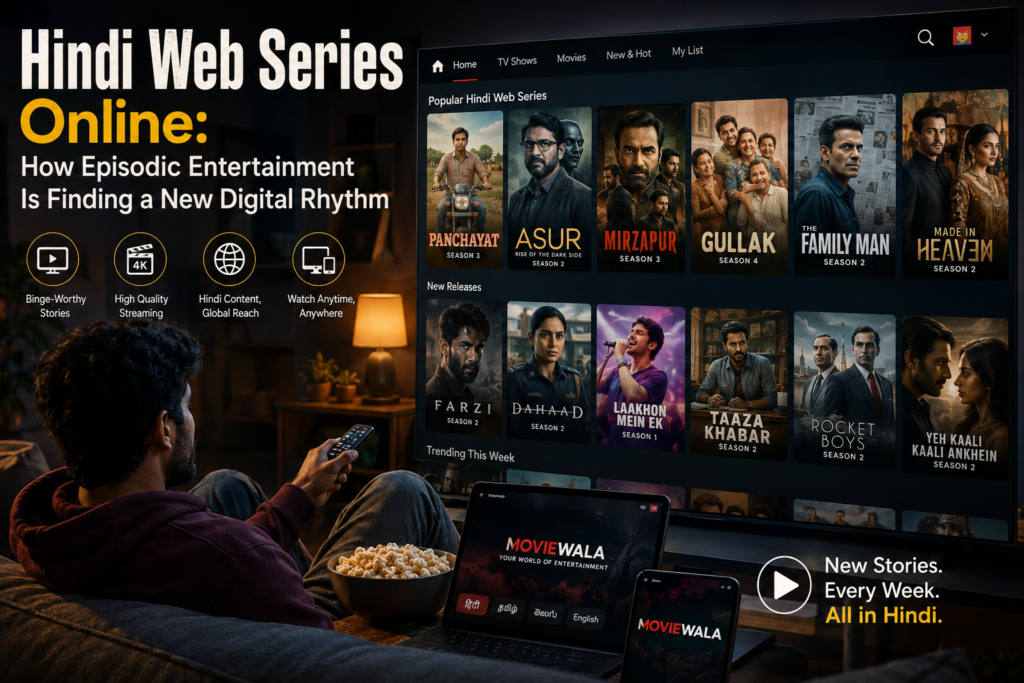
Hindi-language web series have become an important part of India’s rapidly expanding streaming culture, changing the way audiences discover and consume episodic entertainment. Unlike traditional television, where viewers often had to organize their routines around fixed schedules, online series can be explored according to personal availability. For audiences searching for हिंदी वेब सीरीज ऑनलाइन, the digital catalog offers a convenient way to move through contemporary Hindi entertainment while choosing when, where, and how to watch.
From Television Serials to the Streaming Generation
The growth of web series represents more than a change in distribution. It reflects a broader transformation in how Indian audiences interact with episodic content. Traditional television remains important, but streaming has created a parallel environment in which series can be discovered and consumed without depending on a broadcaster’s daily timetable.
India’s Ministry of Information and Broadcasting reports that the country’s online video universe grew from 481 million viewers in 2023 to 547 million in 2024. Its industry analysis also shows that Hindi became increasingly prominent among original series produced for online curated content platforms, while non-Hindi regional production expanded as well.
This development has given Hindi-language episodic entertainment considerably more room to evolve. A series no longer has to fit exclusively into the traditional television model. Digital platforms can support different episode lengths, seasonal structures, genres, and viewing patterns, allowing Hindi web entertainment to develop its own identity.
Why Episodic Viewing Fits Modern Routines
A movie generally represents a single viewing decision, while a series can become part of a longer entertainment routine. Viewers may watch one episode during a short break, continue later in the evening, or return to the same series over several days.
Streaming is particularly well suited to this behavior because the audience controls the pace. There is no requirement to be available when an episode begins broadcasting. The viewer decides when to start, pause, continue, or return to the catalog.
This flexibility is increasingly relevant in India, where smartphone adoption and affordable data have helped make streaming a mainstream form of entertainment. By April 2026, India’s OTT market had reached approximately 1.45 billion monthly active users, according to data reported by IBEF, with smartphones and affordable mobile data identified as major drivers.
For Hindi web series, this mobile-first environment creates an especially broad opportunity. Episodic entertainment can fit into the small spaces of everyday life rather than requiring viewers to reserve an entire evening for television.
The Expanding Genre Map of Hindi Series
Hindi web series are no longer associated with one particular style of programming. The digital environment supports drama, comedy, romance, crime, thriller, mystery, action, fantasy, family entertainment, social subjects, and hybrid formats that combine characteristics from several genres.
This diversity changes the way audiences approach a catalog. A viewer may arrive looking for a particular type of series but discover another category through related shelves or recommendations. Instead of following a broadcaster’s predetermined sequence, the viewer can create a personal route through Hindi episodic entertainment.
The larger the catalog becomes, the more important organization becomes as well. Clear genre sections, useful search tools, recent additions, and curated collections can prevent a large selection from becoming overwhelming.
A strong interface therefore does not simply display more series. It helps viewers understand the relationship between them, making discovery faster while leaving enough room for spontaneous browsing.
Hindi Series and the Wider Indian Streaming Market
The growth of Hindi web series is taking place within a much larger transformation of India’s media landscape. Hindi remains one of the dominant languages for digital entertainment, but audiences are simultaneously consuming content in Tamil, Telugu, Bengali, Malayalam, Marathi, and other Indian languages.
The Ministry of Information and Broadcasting’s current OTT-platform registry demonstrates the scale of this ecosystem, with a large number of services operating across different segments of India’s online video market.
This multilingual environment is important for Hindi web series because it changes the competitive landscape. Hindi content can reach a massive domestic audience while also competing for attention within an increasingly diverse Indian streaming market.
For viewers, however, the result is greater choice. A digital catalog can place Hindi entertainment within a broader environment where audiences can move between languages according to their interests without returning to traditional television distribution.
The Rise of International Interest in Indian Series
Hindi web series are also becoming part of India’s growing international streaming presence. Indian films and series recorded 688 million global views on Netflix during the first half of 2026, demonstrating the increasing international visibility of Indian-language entertainment.
This global reach matters because episodic entertainment can travel particularly well through digital platforms. A viewer outside India does not necessarily need access to a local Hindi television channel to discover contemporary Indian series. Online distribution can make Hindi-language entertainment accessible through the same type of digital interface used for international productions.
For the Indian diaspora, this can provide an additional connection to Hindi-language entertainment. For international audiences, it offers an opportunity to discover contemporary Indian production without requiring physical proximity to India’s traditional entertainment markets.
Localization, subtitles, multilingual interfaces, and increasingly sophisticated recommendation systems can further reduce the distance between Hindi-language content and viewers who are not native Hindi speakers.
A Digital Catalog Built Around Discovery
One of the most important differences between television and streaming is the role of the catalog itself. Traditional television primarily asks audiences to follow programming. Streaming asks audiences to explore.
This makes interface design a central part of the viewing experience. When a viewer opens a Hindi web-series catalog, the organization of the shelves immediately influences what becomes visible. Genre categories, curated collections, recent additions, and intuitive search can guide discovery without forcing viewers into a predetermined path.
A frictionless platform should make the transition from discovery to playback equally straightforward. Moviewala’s catalog-oriented approach allows viewers to browse Hindi entertainment, select a series directly from the shelf, and move toward playback without a mandatory registration wall. An interface without annoying pop-ups also keeps attention on the available content rather than unnecessary interruptions.
This is particularly useful with episodic entertainment because viewers may want to investigate several series before deciding where to begin. Direct access makes that comparison process more comfortable and less time-consuming.
One Screen Is No Longer Enough
The modern web-series audience moves between devices throughout the day. Smart TVs provide a natural environment for longer viewing sessions, while laptops and desktops offer flexible access. Smartphones and tablets make episodic entertainment available in more portable situations.
The growth of connected television adds another dimension to this behavior. Ormax data cited by IBEF estimated India’s active connected-TV base at 129.2 million in 2025, representing an 87% increase within a year.
For Hindi web series, this creates a genuinely multi-screen environment. An episode might begin on a phone and later be watched on a television, while another viewer may use a laptop as the primary screen throughout.
A well-designed platform therefore needs responsive navigation and adaptable playback. The catalog should remain recognizable across screen sizes, while episode selection and playback controls should stay easy to understand.
The Engineering Behind Continuous Episode Playback
Streaming an episodic series involves a complex technical infrastructure because audiences repeatedly return to the catalog for additional content. Cloud-based delivery, content distribution networks, efficient compression, and adaptive bitrate streaming all help support reliable playback.
Video compression reduces the amount of data required to deliver high-quality content, while adaptive streaming can respond to changing network conditions. Distributed delivery infrastructure can also help reduce latency for viewers accessing content from different regions.
For international Hindi audiences, these systems become particularly important. Viewers may connect from India, the Gulf, Europe, North America, or other markets using very different internet services and devices.
The engineering should remain invisible to the audience. When it works effectively, viewers simply select a series, open an episode, and continue watching without having to think about servers, codecs, bandwidth management, or content delivery.
Accessibility Is Becoming Part of Streaming Design
The expansion of online entertainment has also increased attention to accessibility. In March 2026, India’s Ministry of Information and Broadcasting announced accessibility guidelines for OTT platforms covering features intended to improve access for audiences with hearing and visual impairments.
For Hindi web series, accessibility can include more than language support. Captions, readable interface elements, audio-related features, adaptable controls, and other design considerations can make episodic entertainment easier to use for a wider range of viewers.
This reflects a broader evolution in streaming design. Premium usability is increasingly about removing unnecessary barriers rather than simply adding more features.
The best interface can remain visually simple while quietly supporting different needs. Viewers should be able to browse, understand the catalog, select an episode, and begin playback without encountering avoidable friction.
Where Hindi Web Series Are Heading
The future of Hindi episodic entertainment is likely to be shaped by continued growth in mobile viewing, connected television, multilingual catalogs, improved accessibility, and increasingly sophisticated content discovery. India’s digital media market continues to expand, with OTT revenues projected to grow strongly through the remainder of the decade.
At the same time, the growing international performance of Indian series suggests that Hindi web entertainment will increasingly operate within a global streaming environment. The language remains central to the identity of the content, but digital distribution allows it to travel much further.
For audiences, the most meaningful change is control. They can browse when convenient, choose a genre, open a series directly from the catalog, and continue watching across the screens that fit their routines.
The experience can remain calm and straightforward. Open the Moviewala Hindi catalog, explore the available series, select a title from the shelf, choose an episode, and press play. With high-quality playback, direct access, no registration wall, and no distracting pop-ups, the technology can stay in the background while Hindi episodic entertainment becomes the focus.

